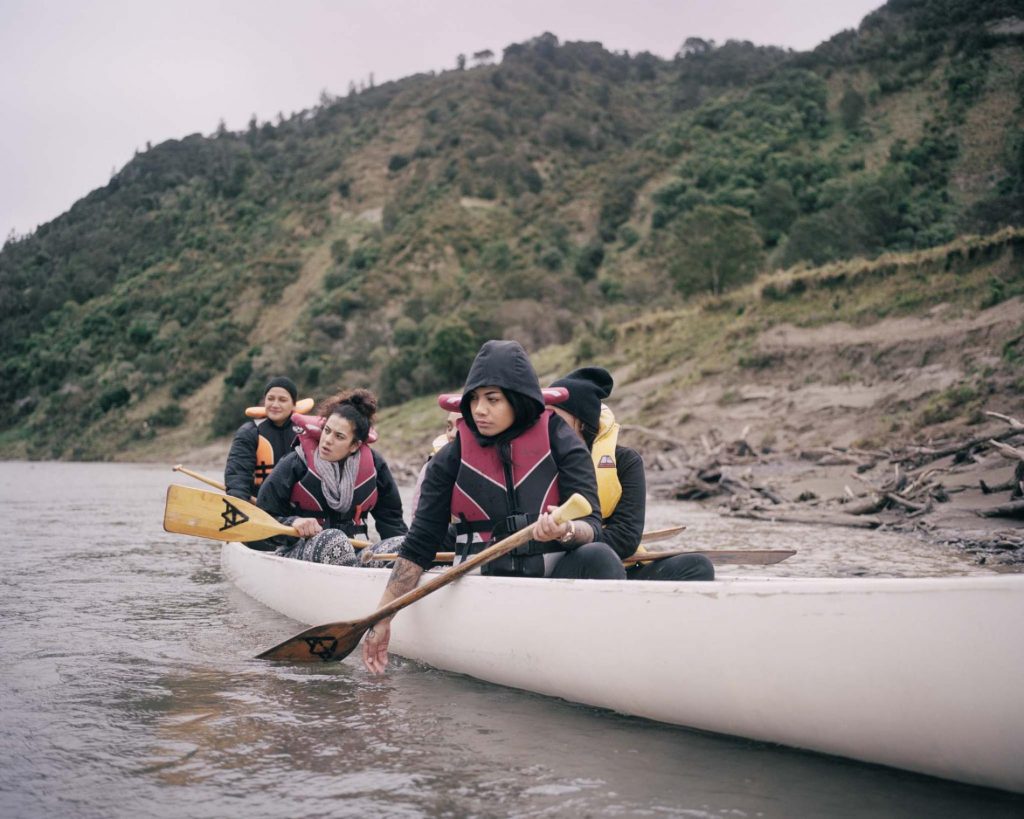
The Whanganui River in New Zealand is a legal person. A nearby forest is too. Soon, the government will grant a mountain legal personhood as well. Here’s how it happened, and what it may mean.
BY KENNEDY WARNE
PHOTOGRAPHS BY MATHIAS SVOLD
“The great River flows from the mountains to the sea. I am the River, the River is me.”
With these words, the Maori tribes of Whanganui, New Zealand, declare their inseverable connection to their ancestral river. The river rises in the snowfields of a trio of volcanoes in central North Island. The tribes say that a teardrop from the eye of the Sky Father fell at the foot of the tallest of these mountains, lonely Ruapehu, and the river was born.

NGM MAPS
Swelled by myriad tributaries, it twists like an eel through mountainous country—part of it a national park—on its 180-mile journey to the sea. Travel the precipitous River Road, and far below you will see canoeists drifting down the placid reaches, at one with the current and its cargo of flotsam and foam, then digging their paddles deep to hurtle through a rapid.
This is the river that for more than 700 years the Whanganui tribes controlled, cared for, and depended on. It is their awa tupua—their river of sacred power. But when European settlers arrived in the mid-1800s, the tribes’ traditional authority was undermined—and finally extinguished by government decree.

Since then, they have watched their river be degraded and disgraced, even as it was feted as a scenic wonder—“The Rhine of New Zealand.” It’s rapids were dynamited to create easier passage for tourist paddle steamers. Its gravel was extracted for railway ballast and road metal, damaging the river’s bed and harming its fisheries. Its mouth became a drain for a city’s effluent.
Most grievous of all, its headwaters were diverted into a different catchment as part of a sprawling hydroelectric power scheme, depriving the river’s upper reaches of its natural flow. That act of aquatic decapitation was a deep cultural affront. In Maori understanding, the head is the most sacred part of any person, and to them, this river is indeed a person—a tupuna, or ancestor.

But on March 20, 2017, something remarkable happened. New Zealand recognized in law what Maori had been insisting all along: The river is a living being. Parliament passed legislation declaring that Te Awa Tupua—the river and all its physical and metaphysical elements—is an indivisible, living whole, and henceforth possesses “all the rights, powers, duties, and liabilities” of a legal person.
This is not the only such statute. Based on the Whanganui precedent, 820 square miles of forests, lakes, and rivers—a former national park known as Te Urewera—also gained legal personhood. Soon a mountain, Taranaki, will become the third person.

Elsewhere in the world there have been attempts to establish legal rights for nature, including for India’s sacred Ganges and Yamuna Rivers. In February of this year, voters in Toledo, Ohio, voted to grant legal standing to Lake Erie. In the wake of these initiatives, the question uppermost in many minds is whether such legislative devices will prove to have teeth in the courtroom. For instance, will nature be able to sue humans for the damage they inflict?

The answer is: No one knows. No lawsuits have yet been brought. It is difficult to speculate what the outcomes would be.
For Maori leaders, the focus on legal rights is misplaced. What matters is a new orientation of humans to the natural world, one based not on rights but responsibilities. Or to paraphrase John F. Kennedy: “Ask not what nature can do for you—ask what you can do for nature.”
The primary intent of New Zealand’s statutes is to address long-standing injustice. They arise from the truth-and-reconciliation journey my country has been making during the past 40 years, seeking to remedy a history of broken promises to Maori. Successive governments (known in constitutional shorthand as “the Crown”) have breached the Treaty of Waitangi, the nation’s founding document, almost since the year it was signed.


Since 1975, a commission of inquiry, the Waitangi Tribunal, has been steadily investigating, reporting, and recommending ways the Crown can resolve grievances brought by the more than a hundred tribes of Aotearoa-New Zealand.
The treaty guaranteed Maori the paramount authority they had exercised for time immemorial over their lands, habitations, and all that they treasured. Without question, the Whanganui chiefs who signed the treaty in 1840 would have considered the river a treasure—a treasure beyond price. It was their food basket, their medicine cabinet, their highway, and their defensive moat. It was their healer, their priest, and their parent. It was the source of their prestige and the core of their being. It was, as the Waitangi Tribunal explained in its report on the Whanganui River treaty claim, the central bloodline of their one heart.
Their knowledge of the river was profound. They knew how, when, and where to take 18 species of freshwater fish, along with mussels, crayfish, and shrimp. They specialized in building massive latticework timber weirs to catch their staple food, eels, which they took in the thousands. They knew and named all 239 rapids that existed in the navigable part of the river. They knew the spirit guardians, called taniwha, who inhabited each river bend.
Their settlements—in the 1800s there were 143 of them—nestled in a strip of land between river and forest. Some clifftop communities used vine ladders to get down to the river. They would pull up the ladders to thwart a raiding party.


They could repel their tribal enemies, but they couldn’t thwart a settler government intent on wresting control of their river from them. In 1903, a clause was slipped into a minor piece of legislation about coal mines that asserted government ownership of all beds of navigable rivers. It was contrary to common law and contrary to the treaty, but it sealed the river’s fate. Whanganui Maori fought the taking of the riverbed in one of the longest spanning legal actions in the country’s history, but it availed them nothing.
Until now. In the new legislation, the Crown issues an apology for its historical wrong-doing, acknowledging that it breached the treaty, undermined the ability of Whanganui tribes to exercise their customary rights and responsibilities in respect of the river, and compromised their physical, cultural, and spiritual well-being.Gerrard Albert reflects on what the legal personhood status signifies to the Maori.
The Crown says it “seeks to atone for its past wrongs and begin the process of healing.” The Te Awa Tupua act, it says, represents “the beginning of a renewed and enduring relationship,” with the river at its center.
It’s a humbling statement for a government to make. But it doesn’t restore ownership of the river to the Whanganui tribes. Politically, that remains a bridge too far, even for a country that believes its future lies in a genuine “treaty partnership” between Maori and non-Maori.

What does the legislation achieve, then?
“Recognition,” says Gerrard Albert, chairman of the Whanganui tribal collective. Recognition that the river is the “indivisible and living whole” of Maori understanding, and not the fragmented, inanimate components of water, bed, banks, tributaries, and catchment that has been the European approach. Recognition too of the inalienable connection between the tribes and the river.
The legal framework flows naturally from the recognition of the river as a person and an ancestor. In families, we tend not to focus on rights but on mutual obligations. That nature is family is central to Maori cosmology. They see the living world as an extended relationship network, in which humans are neither superior nor inferior to any other life form. All are linked by shared descent from Earth and sky.

Maori recognitions are “the sharp end of the waka [canoe] around which the water bends,” Albert told me when I met him in Whanganui city. He sees in the river personhood status “an opportunity for Maori and Pakeha to orient ourselves around the river, remove the barriers to cooperation, and focus on what’s good for everybody, awa included.” (“Pakeha” is the word Maori use for non-Maori New Zealanders.)
Many Pakeha—I am one—have welcomed the Whanganui and Te Urewera personhood laws and the reckoning with history from which they spring. We want to face the uncomfortable truths of our nation’s past, because we want the reconciliation that comes when injustice is confronted and remedies applied.
But as well as the reckoning, there is a beckoning. Maori values of connectivity to nature, a relational view of the world, an ethic of reciprocity, a sacred regard for the whole of creation—these principles of personhood seem intrinsically right, not to mention desperately necessary to resolve humanity’s environmental crises, and many of us want to move toward that way of being.

Can Te Awa Tupua help us with that? I asked Albert. Is there a pathway for Pakeha to share in Whanganui’s declaration of identity, to say “I am the river, the river is me?”
He told me a story. When one of the tribal leaders who brought the Whanganui River claim died in 2010, his body was taken down the river to the burial place by jet boat. “I was in the boat following,” Albert said. “Lining the banks were all these Pakeha farmers holding fern fronds. As the boat passed, they put their ferns in the water”—the traditional Maori way to honor the life force of water. “They were acknowledging what he stood for and fought for.
“Te Awa Tupua is an inclusive proposition. Considering where we are globally, environmentally, if my child is standing on a cliff about to fall off, does it matter if I get to grab that child to stop them falling or someone else does? We have a saying: The small streams and the large streams flow together. That’s a metaphor for communities. We’re all responsible for the welfare of the river.”

Albert Einstein wrote in 1950 that the presumption that humans are separate from nature is “an optical delusion of consciousness,” and something of a cultural prison. “Our task must be to free ourselves from this prison,” he wrote, “by widening our circles of compassion to embrace all living creatures and the whole of nature in its beauty.”
Einstein’s theme was taken up and given forceful expression by the American legal philosopher Christopher Stone in his 1972 paper, “Should trees have standing?—towards legal rights for natural objects.” In that paper, he called for a “radical new theory” of the human relationship to nature.
Presciently, Stone noted that the problems human beings now confront are “the worldwide crises of a global organism: not pollution of a stream, but pollution of the atmosphere and of the ocean. Increasingly, the death that occupies each human’s imagination is not his own, but that of the entire life cycle of the planet earth, to which each of us is as but a cell to a body.”
More than 40 years later, a handful of laws is beginning to give effect to Stone’s “radical new theory.” A river in New Zealand has led the way.
Mathias Svold is a documentary photographer based in Denmark. He pursues long-and short-term projects about the relationship between the climate, nature, and culture. Mathias photographed this story as a National Geographic’s summer intern in 2018. Follow him on Instagram @mathiassvold.
Kennedy Warneco-founded New Zealand Geographic in 1988, and has written for National Geographic since 2000. His book Tuhoe: Portrait of a Nation explores one of New Zealand’s other legal persons: the area of forest known as Te Urewera.
Produced By – Shweta Gulati; Photo Editors – Molly Roberts, Shweta Gulati; Text Editor – Oliver Payne.
Source : https://www.nationalgeographic.com/